
S.A.B.L.E. — STRATEGIC ALLIANCE FOR BLACK LIBERATION & EQUITY
CASE FILE NO. 003 — YELLOW HAMMER
CLASSIFICATION: EYES ONLY — RELEASED TO THE WALL
DATE OF FILING: February 5, 2003
SUBJECT: Curveball: the source who became a war
FILED BY: SPECIAL AGENT “THE FLY”
THE WALL
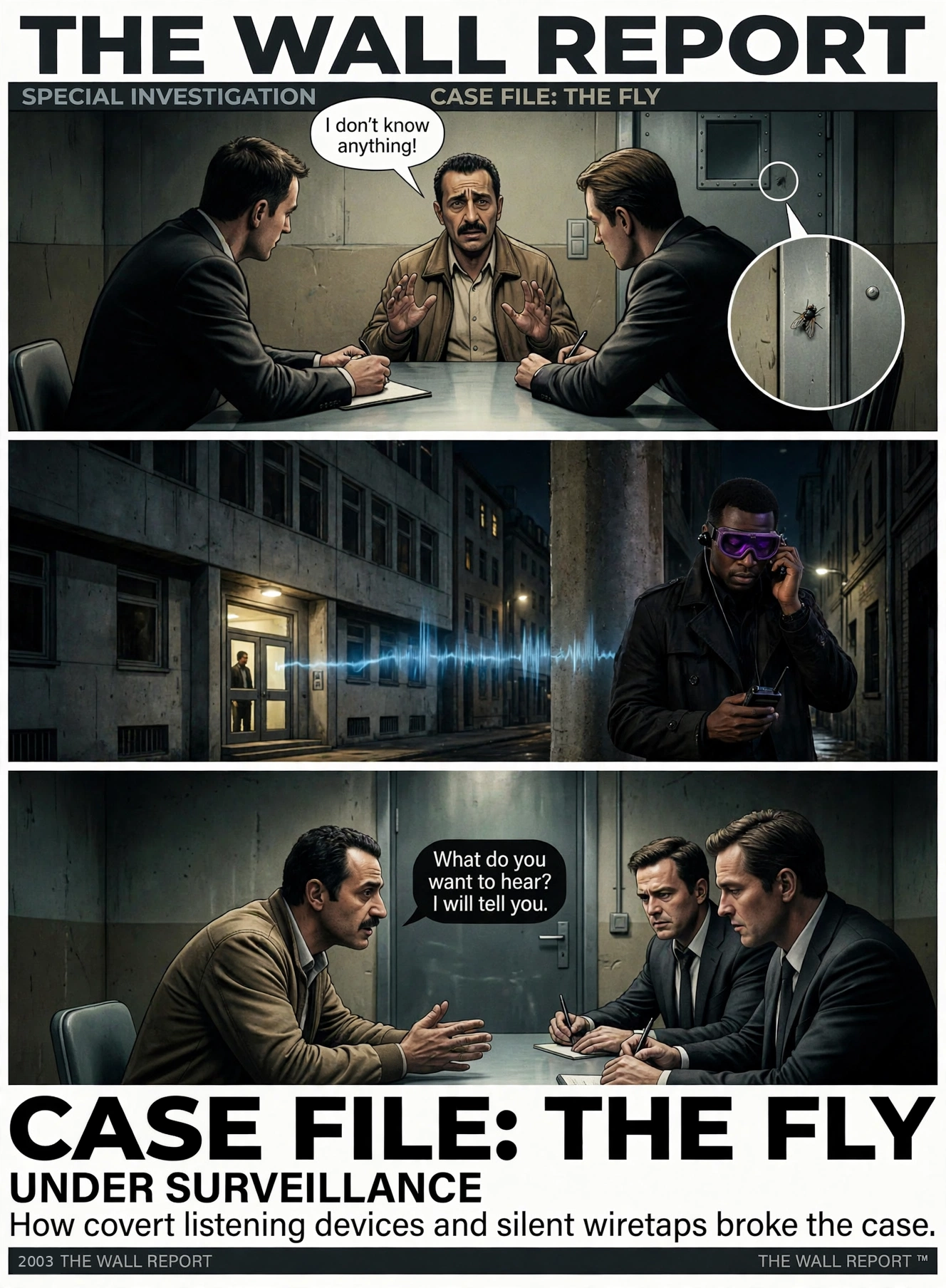
Every interrogation room has three people in it. The man asking. The man answering. And the one on the wall.
The Agency keeps this file under surveillance for a reason: the most important listener in the Curveball affair was never in the room at all — because almost nobody in the chain ever sat in a room with the source. They heard him the way the world hears everything important now. Secondhand. Through a wall. Translated, summarized, and passed along — each handoff making the story a little cleaner, a little surer, a little more certain than the man who told it ever was.
This file is about a codename that people keep mistaking for an operation. There was no Operation Curveball. Curveball was a man. What was done with his words — that was the operation. It just never got a name, because nobody ran it. It ran itself.
THE NAME ON THE FILE
The Agency names this file for the only honest curveball in the story.
Sandy Koufax threw a curve the hitters called the Yellow Hammer — a twelve-to-six drop that started at the letters and finished at the knees. Ernie Banks said Koufax tipped the pitch, held his hands where everybody could read them, and it didn’t matter. Fifty thousand witnesses. The best hitters alive, told in advance what was coming. Froze them anyway — because the pitch was real, thrown in the open, where anyone could see it break.
Now hold that picture next to the other Curveball. His pitch was never thrown where anyone could see it. No crowd. No batter’s eye view. The men who swung the world at it never laid eyes on the pitcher, never watched the ball leave his hand, never even sat in the room where the story was told. Koufax’s hammer broke in broad daylight and hitters still couldn’t touch it. Curveball’s pitch never existed at all — and no one in the chain ever asked to see it.
A real Yellow Hammer needs no laundering. That’s why the name belongs on this file. (The home office notes the echo without further comment: Alabama is the Yellowhammer State.)
THE SOURCE
In 1999, an Iraqi chemical engineer named Rafid Ahmed Alwan al-Janabi arrived in Germany seeking asylum. German intelligence — the BND — took him in and gave him a codename from an American pastime: CURVEBALL.
His story was a masterpiece of the genre. Iraq, he said, had built biological weapons factories on wheels — mobile labs mounted on trucks and rail cars, impossible to bomb because they never sat still. He said he had run one of the facilities himself. He described layouts, accidents, production runs. Detail upon detail, the kind of detail that makes a debriefer’s pen move faster.
There were problems, and the problems were known early. German handlers had their doubts about their source. Allied intelligence officers traveled to check his story against his former boss in Iraq’s Military Industries Commission — and the boss’s account made key parts of Curveball’s tale impossible. One American officer who laid eyes on him in 2000 came away unimpressed. None of it mattered, because of the one fact at the center of this file: the United States, which would use his words to justify a war, never interviewed him before that war began. The BND kept its source. America got the summaries.
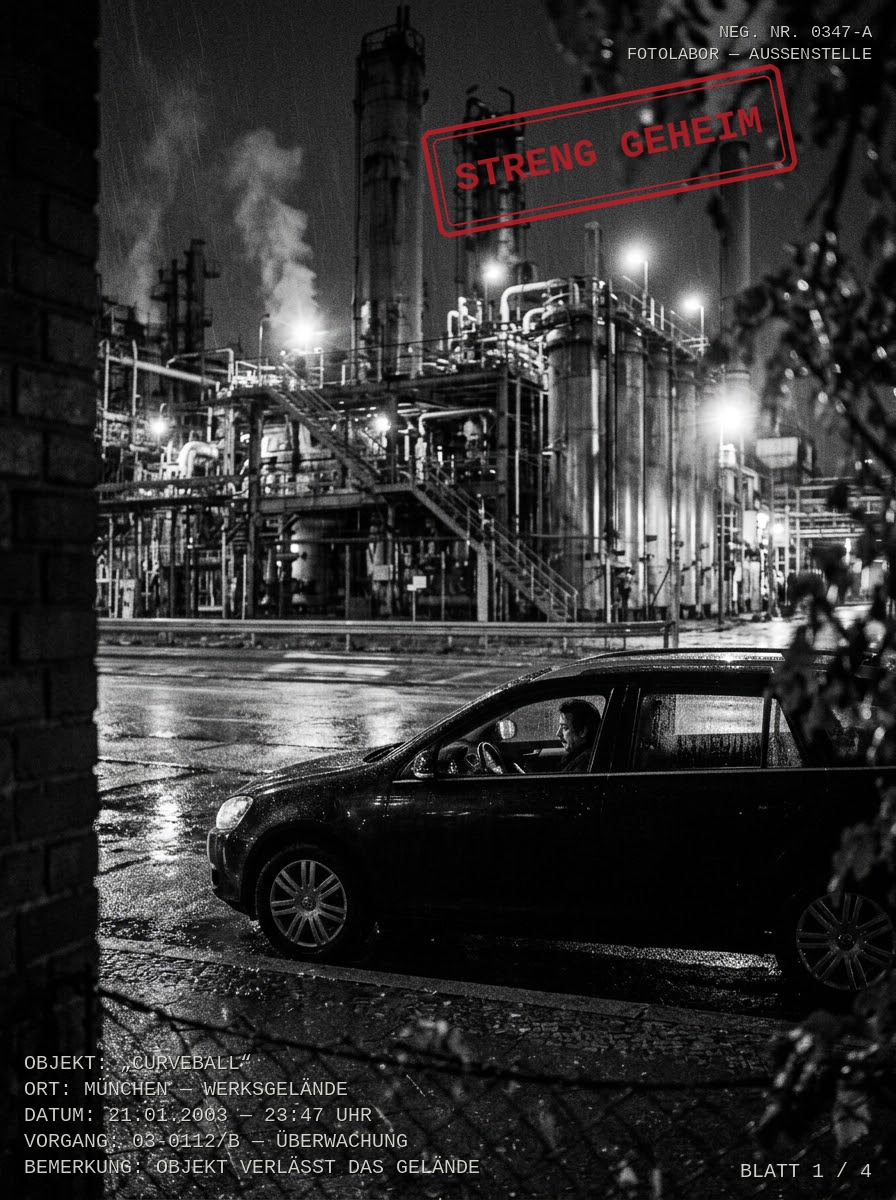
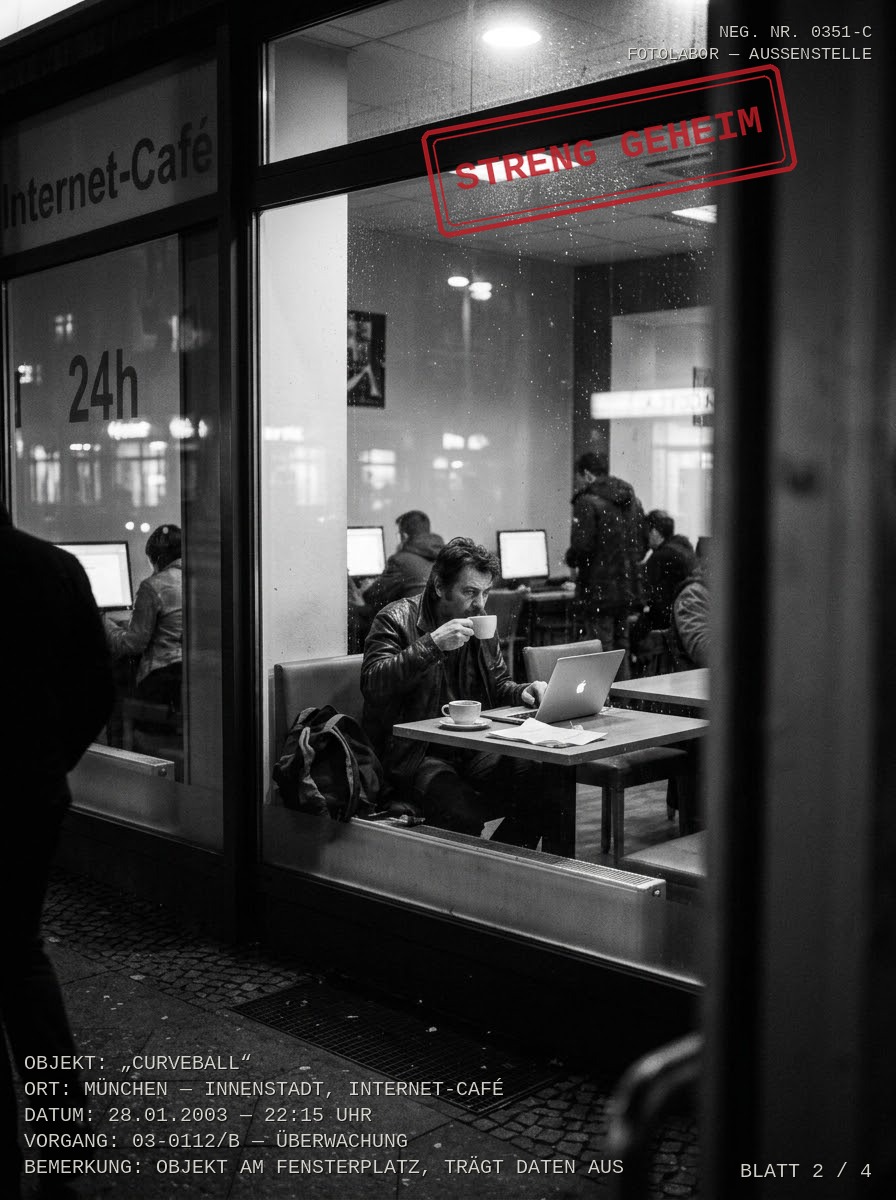
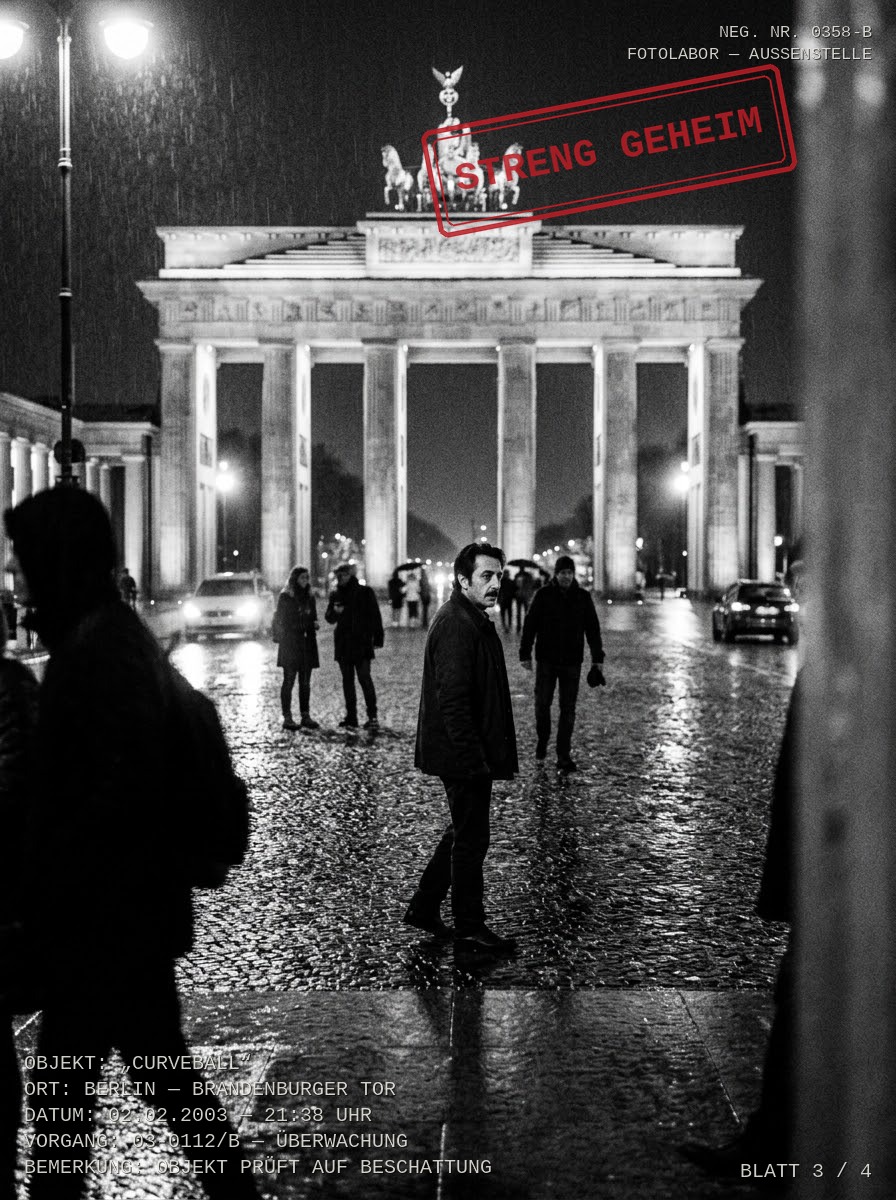
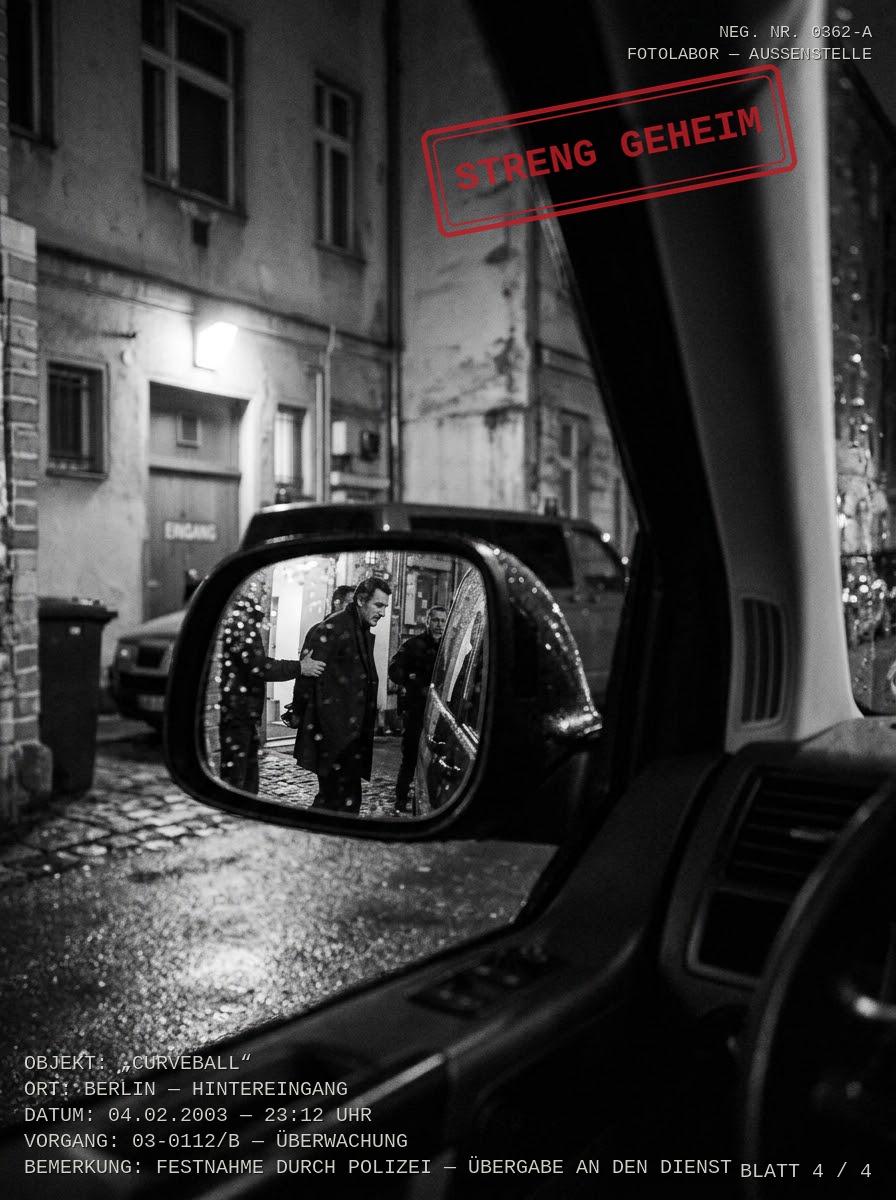
Surveillance plates from the German file, released with this case. The wall had a camera, too.
THE LAUNDERING
Watch how a lie gets cleaned.
BND debriefings become DIA reporting — the doubts noted in the margins, the warnings in the footnotes. The reports become the October 2002 National Intelligence Estimate, where cautious language hardens into assessment. The assessment becomes, on February 5, 2003, Secretary of State Colin Powell standing before the UN Security Council, holding up a vial, walking the world through artist renderings of mobile weapons labs that existed only in one man’s imagination — described to the world as the firsthand account of an eyewitness engineer in hiding.
Somewhere between the debriefing room and that podium, every hedge fell off. Curveball’s file cannot show you the moment, because there wasn’t one. There was only a chain of people, each of whom needed the story to be true a little more than the last man did. A second defector Powell cited in support had already been red-flagged by the DIA as a questionable source. The caution never made the trip up the chain. The story did.
Six weeks later, the invasion began.
WHY THE AGENCY FILES THIS ONE
The Agency files Curveball because it is the cleanest case on record of a principle the Wall exists to teach: an institution will believe exactly what it needs to believe, and call the believing “intelligence.”
Curveball did not fool the system. He fed it. The appetite came first — a government after September 11 that required a casus belli with a technical appendix. One asylum seeker with an engineering degree and a grudge against Saddam Hussein understood the market he was in, and supplied it. The system did the rest itself: it protected its source from scrutiny, promoted his claims past every warning, and put them in the mouth of the most credible man it had.
So when the question comes — was there an Op Curveball? — the file answers: no operation. No program. No campaign. A codename for a man, and a machine that laundered him. The Agency’s interest is not the liar. Liars are common. The Agency’s interest is the laundry.
Watch the chain, not the source. The source is just the man talking. The chain is who chose to listen, what they chose to carry, and what they chose to leave on the floor of the debriefing room.
Somebody is always on the wall. Make sure it’s you.
— THE FLY, SPECIAL AGENT
S.A.B.L.E.
ARCHIVIST’S ADDENDUM
The Archivist appends the record that accumulated after the filing date.
- January 2004 — The Iraq Survey Group’s David Kay testifies that the two trailers found in Iraq, initially presented as the mobile labs, were in fact designed to produce hydrogen (for weather balloons). No mobile biological weapons labs were ever found.
- May 2004 — The CIA formally concludes that Curveball’s reporting was fabricated and withdraws it — fifteen months after it anchored the public case for war.
- July 2004 / 2006 — The Senate Select Committee on Intelligence’s Iraq reports (Phase I and Phase II) document how the Curveball reporting was handled, and how public statements ran ahead of what the intelligence supported.
- 2005 — The Robb–Silberman Commission reaches the same essential finding: the intelligence community’s judgments on Iraqi biological weapons rested heavily on a single, unexamined source.
- February 2011 — Al-Janabi, his identity now public, admits to The Guardian that he invented the mobile labs story, saying he did it for the chance to help topple Saddam’s regime — and that he remains proud of it.
- Colin Powell would call the 2003 presentation a “blot” on his record and a great intelligence failure.
- On the name: the Agency’s open-source review — the National Security Archive’s CURVEBALL collection, the DIA sourcebooks, the Senate reports, the Chilcot Report — finds no operation, program, or campaign named Curveball in any declassified or public record, American, German, British, or otherwise. The codename designated the source. It never designated anything else.
Handle every future source the way this file teaches: ask who carried the story to you, what they needed it to be, and what got left on the floor.
— END OF DISPATCH —


Leave a Reply